
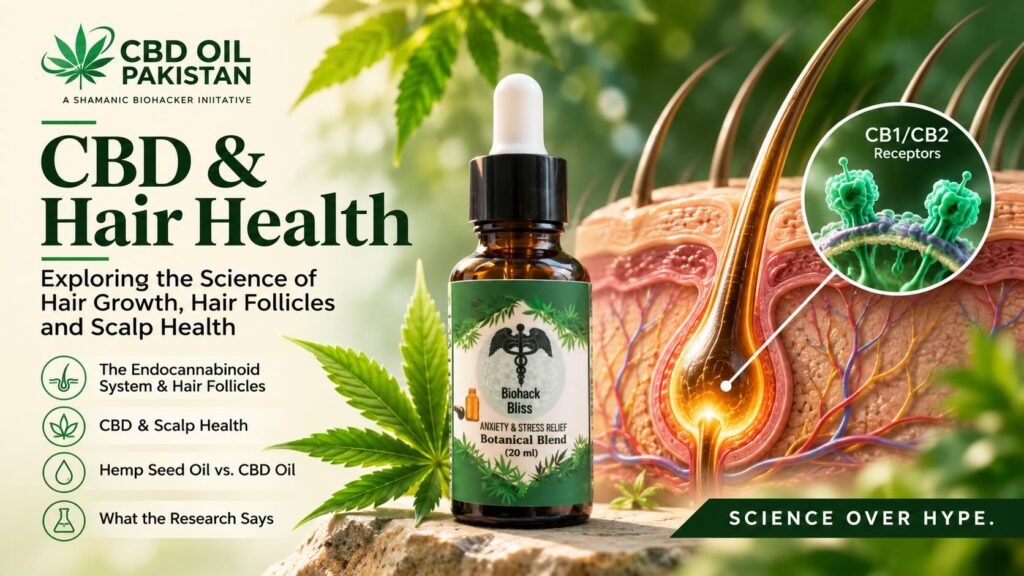
Understanding the endocannabinoid system, cannabinoid signalling, hemp-derived oils and their emerging relationship with hair biology.
Hair health is influenced by considerably more than the products we apply to our scalp. Behind every growing strand is a complex biological structure involving hormones, cellular signalling, nutrition, inflammation and a continuous cycle of follicular regeneration.
One emerging area of scientific interest is the relationship between cannabinoids and hair follicle biology.
Research into the endocannabinoid system (ECS) has revealed that cannabinoid receptors and related signalling molecules are present in human skin and hair follicles. This has encouraged researchers to investigate whether cannabidiol (CBD) and other hemp-derived compounds could have applications in scalp care and hair-related conditions.
But what does the research actually show? Can CBD oil encourage hair growth? Is hemp seed oil different from CBD oil? And could the endocannabinoid system influence the hair growth cycle?
Let’s explore the science.
1. Understanding the Biology of Hair Growth
Before examining CBD, it is important to understand how hair follicles function.
Hair grows from specialised structures called hair follicles, located within the skin. These structures contain several types of cells responsible for producing the hair shaft, regulating growth and responding to biological signals.
Human scalp hair generally progresses through four stages:
Anagen – The Growth Phase
Anagen is the active growth stage. Cells within the hair follicle rapidly divide and differentiate to produce the hair shaft. This phase can last several years, determining the potential length of an individual’s hair.
Catagen – The Transitional Phase
During catagen, active growth slows and the lower portion of the follicle begins to regress. This is a controlled biological process involving cellular changes and programmed cell death.
Telogen – The Resting Phase
The follicle enters a resting period. Hair production temporarily stops, although the existing hair remains attached to the scalp.
Exogen – The Shedding Phase
The existing hair is released, allowing the follicle to begin another growth cycle.
These stages are regulated by a combination of genetic, hormonal, nutritional and environmental factors.
According to Natarelli et al. (2023), inflammation, hormonal changes, nutritional deficiencies, stress and other physiological factors can influence the transition between growth and resting phases.
This is particularly relevant when investigating compounds that interact with the biological signalling systems present in the skin.
2. What Is the Endocannabinoid System (ECS)?
The endocannabinoid system is a biological signalling network found throughout the human body.
It consists primarily of:
Endocannabinoids: Naturally produced signalling molecules.
Cannabinoid receptors: Proteins that respond to cannabinoid-related signals.
Metabolic enzymes: Proteins responsible for synthesising and breaking down endocannabinoids.
Two widely studied receptors are CB1 and CB2.
Although cannabinoid receptors are commonly discussed in relation to the nervous and immune systems, research has also identified components of the endocannabinoid system in human skin.
The skin ECS participates in several biological processes, including cellular differentiation, inflammation, immune responses and the regulation of sebaceous gland activity.
Bíró et al. (2009) explored the importance of this signalling network in maintaining skin physiology and its potential involvement in dermatological conditions.
Importantly, research has also identified endocannabinoid signalling components within human hair follicles.
This raises an interesting scientific question:
Could the endocannabinoid system influence the biological processes responsible for hair growth?
Researchers are investigating precisely this relationship.
3. CBD and Hair Follicles: What Does the Research Say?
Cannabidiol (CBD) is a naturally occurring phytocannabinoid found in Cannabis sativa.
Unlike THC, CBD is not intoxicating. It interacts with several molecular targets and signalling pathways, including components of the endocannabinoid system.
Its potential relationship with hair follicle biology has attracted attention because cannabinoid receptors and related signalling mechanisms are involved in regulating cellular activity.
However, the effects are more complicated than simply suggesting that CBD stimulates hair growth.
The 2020 Journal of Investigative Dermatology Study
One particularly interesting investigation was published by Szabó et al. (2020) in the Journal of Investigative Dermatology.
The researchers examined how CBD interacts with human hair follicle tissue under laboratory conditions.
Their findings suggested that CBD has concentration-dependent effects.
At lower, submicromolar concentrations, CBD demonstrated anti-inflammatory activity in the experimental model.
At higher micromolar concentrations, however, CBD inhibited hair shaft production through mechanisms involving the TRPV4 signalling pathway.
This finding is important because it challenges the assumption that increasing CBD concentration necessarily produces better results.
Instead, the relationship between cannabinoids and hair follicles appears to depend on the concentration, formulation and biological environment.
These findings are laboratory observations, not proof that topical CBD promotes hair growth in humans.
4. The 2021 CBD-Rich Hemp Extract Case Series
Another study that attracted attention was published by Smith and Satino (2021) in the journal Cannabis.
The researchers examined the effects of a topical CBD-rich hemp extract formulation in 35 individuals experiencing androgenetic alopecia, commonly known as male- or female-pattern hair loss.
The formulation was applied once daily over six months.
The authors reported an average increase of approximately 93.5% in non-vellus hair counts within the measured areas.
The study also reported that no adverse effects were observed among the participants.
These findings generated interest in the potential application of CBD-rich topical formulations in hair care.
However, there are important limitations.
This was a small case series, not a large randomised controlled clinical trial. It did not include a placebo comparison group, and the results cannot establish that CBD alone caused the reported hair-count changes.
The formulation also contained a carrier base and other hemp-derived constituents, making it difficult to attribute the findings exclusively to cannabidiol.
Consequently, the study should be considered preliminary evidence that warrants further investigation rather than proof of a clinically established hair-growth treatment.
5. Hemp Seed Oil vs. CBD Oil: Understanding the Difference
One of the most common misunderstandings in the hemp and CBD industry is treating hemp seed oil and CBD oil as interchangeable products.
They are not the same.
Although both originate from Cannabis sativa, their composition and intended applications differ.
Hemp Seed Oil
Hemp seed oil is obtained by pressing hemp seeds.
It is valued for its naturally occurring fatty acids, particularly:
Linoleic acid (omega-6).
Alpha-linolenic acid (omega-3).
Oleic acid (omega-9).
These fatty acids contribute to the oil’s nutritional and cosmetic properties.
When used in hair care formulations, hemp seed oil can function as an emollient, helping condition the hair and improve its feel.
It may also help reduce the appearance of dryness by supporting the hair’s surface conditioning.
However, these cosmetic properties should not be confused with demonstrated stimulation of hair follicle growth.
CBD Oil
CBD oil is produced using extracts containing cannabidiol, generally obtained from cannabinoid-rich parts of the hemp or cannabis plant.
Depending on its formulation, it may contain CBD alongside other plant-derived compounds.
CBD interacts with several molecular targets involved in skin biology, including cannabinoid receptors and transient receptor potential (TRP) channels.
Researchers are investigating how these interactions influence inflammatory signalling, cellular activity and other dermatological processes.
Unlike conventional hemp seed oil, CBD oil is specifically characterised by its cannabidiol content.
The key distinction: Hemp seed oil is primarily a fatty-acid-rich botanical oil, while CBD oil is a cannabinoid-containing formulation. A product containing hemp seed oil does not automatically contain meaningful quantities of CBD.
6. Cannabinoids, Scalp Health and Inflammatory Signalling
The scalp is living skin containing hair follicles, sebaceous glands, immune cells and specialised sensory structures.
Its condition can influence the overall hair-care environment.
Inflammatory processes are relevant to several dermatological conditions, including certain forms of scalp irritation and hair disorders.
The endocannabinoid system has attracted interest because cannabinoid receptors and associated signalling pathways participate in the regulation of skin inflammation and cellular responses.
Yoo and Lee (2023), in their review published in the International Journal of Molecular Sciences, discussed the potential dermatological applications of cannabinoids.
Their review covered several areas of research, including:
Skin inflammation and immune signalling.
Sebaceous gland activity.
Cannabinoid receptor expression.
Psoriasis and other inflammatory skin conditions.
Hair follicle biology and emerging hair-related applications.
Although these findings provide a scientific basis for further investigation, most cannabinoid research in dermatology remains preclinical.
It is therefore premature to conclude that CBD oil can treat scalp disorders or prevent inflammatory hair loss in humans.
7. CBD, Hormones and Pattern Hair Loss
Hormonal signalling plays an important role in certain types of hair loss.
One well-known example is androgenetic alopecia.
This condition is associated with genetic susceptibility and sensitivity to androgens, particularly dihydrotestosterone (DHT), which can contribute to progressive hair follicle miniaturisation.
Over time, affected follicles may produce progressively finer and shorter hairs.
Other forms of hair loss can have different underlying causes, including:
Thyroid dysfunction.
Nutritional deficiencies.
Stress-related telogen effluvium.
Autoimmune conditions.
Certain medications.
Hormonal changes.
Because hair loss has multiple potential causes, identifying the underlying condition is essential.
The endocannabinoid system is involved in biological signalling within the skin, but there is currently insufficient clinical evidence to establish CBD as a treatment for DHT-related hair loss or hormonal imbalance.
Researchers continue to investigate possible interactions between cannabinoids, follicular receptors and the molecular pathways involved in hair cycling.
8. An Important Scientific Complication: Cannabinoids Can Also Inhibit Hair Growth
A balanced discussion of CBD and hair health must include research that has identified potentially inhibitory effects.
Telek et al. (2007), publishing in the FASEB Journal, investigated the effects of endocannabinoids and exogenous cannabinoids on human hair follicles maintained in organ culture.
Their findings showed that anandamide and THC could inhibit hair shaft elongation and promote premature follicular regression through CB1-related signalling.
This study demonstrates that cannabinoid activity within hair follicles is not automatically beneficial.
The later research by Szabó et al. (2020) further demonstrated that CBD itself can have different effects depending on concentration.
Together, these studies suggest that cannabinoid signalling in hair follicles is complex and requires careful investigation.
The important takeaway is that the biological effects of individual cannabinoids cannot be generalised across all cannabinoid-containing products.
The type of cannabinoid, its concentration, delivery method and interaction with specific receptors all matter.
9. What Does Current Research Actually Establish?
The scientific evidence can be separated into three broad categories.
What is established:
Human hair follicles contain components of the endocannabinoid signalling system.
Hair growth is regulated by complex hormonal, cellular and molecular processes.
Hemp seed oil contains fatty acids with cosmetic conditioning applications.
CBD interacts with several molecular targets relevant to skin biology.
What is emerging:
CBD may influence hair follicle signalling under specific experimental conditions.
Certain topical CBD-rich formulations have produced preliminary hair-count findings.
Cannabinoids may influence inflammatory pathways relevant to dermatological health.
What remains unproven:
CBD oil reliably stimulates hair growth in the general population.
CBD prevents androgenetic alopecia.
CBD treats hormonal hair loss.
CBD reverses follicular miniaturisation.
Hemp seed oil or CBD oil can replace established dermatological treatments.
A 2022 review by Gupta and Talukder highlighted the concentration-dependent nature of cannabinoid effects on hair follicles and concluded that further research is required to establish the safety and efficacy of topical cannabinoid preparations.
This distinction between experimental findings and established clinical outcomes is essential when evaluating emerging botanical applications.
10. Practical Considerations for Hair and Scalp Care
Regardless of whether someone is exploring conventional hair-care products or emerging botanical formulations, a few principles remain important.
Understand the underlying cause of hair loss.
Persistent or sudden hair loss should be evaluated by a qualified dermatologist. Different conditions require different approaches.
Distinguish cosmetic conditioning from hair growth.
An oil that improves hair softness or reduces the appearance of dryness does not necessarily stimulate new follicular growth.
Check product composition.
Hemp seed oil, CBD isolate, broad-spectrum CBD and full-spectrum hemp extracts are different formulations. Their cannabinoid content should be clearly identified.
Pay attention to formulation and concentration.
Research suggests that cannabinoid effects on hair follicles may be concentration-dependent. More CBD does not necessarily mean better results.
Consider skin sensitivity.
Topical botanical formulations may cause irritation or allergic reactions. Patch testing and appropriate product guidance are sensible precautions.
Do not replace established treatments.
People experiencing significant hair loss should discuss evidence-based treatment options with a dermatologist rather than replacing prescribed therapies with unproven botanical products.
Conclusion: The Future of Cannabinoid Research in Hair Health
The relationship between CBD, hemp-derived oils and hair follicle biology is an emerging area of dermatological research.
The discovery of endocannabinoid signalling within human hair follicles has opened new avenues for investigating how cannabinoids interact with cellular processes involved in hair growth and regeneration.
Preliminary research involving CBD-rich topical formulations has produced interesting findings, while laboratory studies have demonstrated that cannabinoid effects can vary considerably depending on concentration and receptor activity.
At the same time, hemp seed oil offers a distinct cosmetic application through its naturally occurring fatty acids and conditioning properties.
However, the distinction between promising laboratory findings and clinically demonstrated hair-growth benefits must remain clear.
CBD oil is not currently an established treatment for hair loss, androgenetic alopecia or hormonal hair disorders.
As research develops, better-controlled clinical trials will be necessary to determine which cannabinoid formulations, concentrations and applications — if any — can offer meaningful benefits for human hair health.
At SHAMANIC BIOHACKER, we believe that understanding the biology behind botanical compounds is more important than making exaggerated promises.
SCIENCE OVER HYPE. NATURE, UNDERSTOOD.
Frequently Asked Questions (FAQs)
1. Can CBD oil promote hair growth?
Preliminary research suggests that CBD may influence hair follicle activity under specific experimental conditions. However, clinical evidence remains insufficient to establish CBD oil as an effective hair-growth treatment.
2. Is hemp seed oil the same as CBD oil?
No. Hemp seed oil is pressed from hemp seeds and contains fatty acids. CBD oil contains cannabidiol extracted from cannabinoid-rich plant material. Hemp seed oil does not automatically contain meaningful amounts of CBD.
3. Does CBD help with hormonal hair loss?
There is currently insufficient clinical evidence to establish CBD as a treatment for androgenetic alopecia or DHT-related hair loss.
4. Can CBD oil be applied directly to the scalp?
Topical cannabinoid formulations are being investigated in dermatological research. However, suitability depends on the formulation, concentration and individual skin sensitivity. Not every CBD product is designed for scalp application.
5. What is the relationship between the endocannabinoid system and hair follicles?
Research has identified cannabinoid receptors and endocannabinoid signalling components within human hair follicles. These pathways may influence follicular cellular activity and hair-cycle regulation.
6. Does CBD have anti-inflammatory properties?
Experimental research has identified anti-inflammatory activity associated with CBD in several biological models. However, these findings do not establish that topical CBD treats inflammatory scalp conditions in humans.
7. Is CBD a replacement for conventional hair-loss treatments?
No. CBD is not an established replacement for clinically recognised hair-loss treatments. Anyone experiencing persistent hair loss should seek a proper dermatological assessment.
Scientific References (APA 7th Edition)
The following peer-reviewed publications provide the scientific foundation for this article. Click each title to access the original publication or its full text.
Bíró, T., Tóth, B. I., Haskó, G., Paus, R., & Pacher, P. (2009). The endocannabinoid system of the skin in health and disease: Novel perspectives and therapeutic opportunities. Trends in Pharmacological Sciences, 30(8), 411–420. https://doi.org/10.1016/j.tips.2009.05.004
Gupta, A. K., & Talukder, M. (2022). A cannabinoid hairy-tale: Hair loss or hair gain? Journal of Cosmetic Dermatology, 21(12), 6653–6660. https://doi.org/10.1111/jocd.15427
Natarelli, N., Gahoonia, N., & Sivamani, R. K. (2023). Integrative and mechanistic approach to the hair growth cycle and hair loss. Journal of Clinical Medicine, 12(3), 893. https://doi.org/10.3390/jcm12030893
Smith, G. L., & Satino, J. (2021). Hair regrowth with cannabidiol (CBD)-rich hemp extract: A case series. Cannabis, 4(1), 53–59. https://doi.org/10.26828/cannabis/2021.01.003
Szabó, I. L., Lisztes, E., Béke, G., Tóth, K. F., Paus, R., Oláh, A., & Bíró, T. (2020). The phytocannabinoid (−)-cannabidiol (CBD) operates as a complex, differential modulator of human hair growth: Anti-inflammatory submicromolar versus hair growth inhibitory micromolar effects. Journal of Investigative Dermatology, 140(2), 484–488.e5. https://doi.org/10.1016/j.jid.2019.07.690
Telek, A., Bíró, T., Bodó, E., Tóth, B. I., Borbíró, I., Kunos, G., & Paus, R. (2007). Inhibition of human hair follicle growth by endo- and exocannabinoids. The FASEB Journal, 21(13), 3534–3541. https://doi.org/10.1096/fj.06-7689com
Yoo, E. H., & Lee, J. H. (2023). Cannabinoids and their receptors in skin diseases. International Journal of Molecular Sciences, 24(22), 16523. https://doi.org/10.3390/ijms242216523
Medical and scientific disclaimer: This article is intended for educational and informational purposes only. It does not constitute medical advice, diagnosis or treatment recommendations. CBD and hemp-derived products are not established treatments for hair loss or hormonal disorders. Consult a qualified healthcare professional regarding persistent hair loss or scalp conditions.
Published by: CBD OIL PAKISTAN
A SHAMANIC BIOHACKER initiative.
Website: https://cbdvape-pakistan.com/
Email: info@cbdvape-pakistan.com
- All
- Blog
- CBD Honey
- CBD Oil
The Gut–Brain Connection: How the Vagus Nerve, Endocannabinoid System & CBD Interact
CBD Oil, Hemp & Hair Growth: Exploring the Science of Hair Follicles and Scalp Health
How to Get a CCRA Cannabis License in Pakistan in 2026: Cultivation, Processing & R&D
What Is CBD Oil? The Complete 2025 Beginner’s Guide for Pakistan
🧠 CBD Oil & Cognitive Health: What Older Adults in Pakistan Should Know
🧠 CBD Oil and Epilepsy: The Science Behind Seizure Control in Pakistan
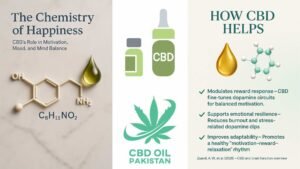
CBD and Dopamine: The Science of Motivation & Happiness
🧠 CBD Oil & ADHD in Pakistan: What 2025 Research Reveals About Focus, Calm & Neurobalance
New 2025 Research: Full-Spectrum Hemp Provides Rapid Migraine Relief
Introduction: A Breakthrough for Migraine Relief Migraines are among the most debilitating neurological conditions, impacting millions worldwide—including countless individuals in Pakistan. Traditional medications often come
New 2025 Study: CBD Oil Shows Promise in Protecting Organs During Chemotherapy
Introduction: A Breakthrough for 2025 Chemotherapy remains one of the most widely used—and most taxing—cancer treatments. While effective against tumors, it often damages vital organs

🌿 Khwaja Khizar & Cannabis: The Mystical Legacy of Green Wellness in Pakistan
In Islamic and South Asian spirituality, Khwaja Khizar — also known as Al-Khidr — is a mysterious, immortal figure associated with guidance, greenery, and divine
CBD Oil Chemotherapy Protection Pakistan | 2025 Research
CBD Oil Chemotherapy Protection in Pakistan: Why It Matters CBD Oil Chemotherapy Protection in Pakistan is gaining attention as 2025 research shows its potential to
CBD and Autism in 2025: What New Research Reveals
Exploring science, safety, and potential in Full Spectrum CBD for ASD As parents and clinicians alike seek safer, more natural interventions for autism spectrum disorder
CBD Oil in Pakistan for OCD: Can It Help Manage Symptoms Naturally?
As conversations about holistic health gain momentum, many in Pakistan are exploring CBD oil as a natural support tool for mental wellness. Among the conditions