Introduction: Floods, Climate Change, and Pakistan’s Urgent Need
Every year, Pakistan braces for the monsoon season with dread. The floods of 2022, which submerged one-third of the country and displaced over 8 million people, remain etched in collective memory. In 2025, floods have again devastated Punjab, forcing over 1 million evacuations and submerging 1,400 villages (Reuters, 2025; AP News, 2025).
Clearly, Pakistan cannot afford “business as usual.” The search for sustainable, nature-based solutions has never been more urgent. And here, the humble hemp plant may hold an answer.
Thailand’s Experience: How Hemp Fights Floods
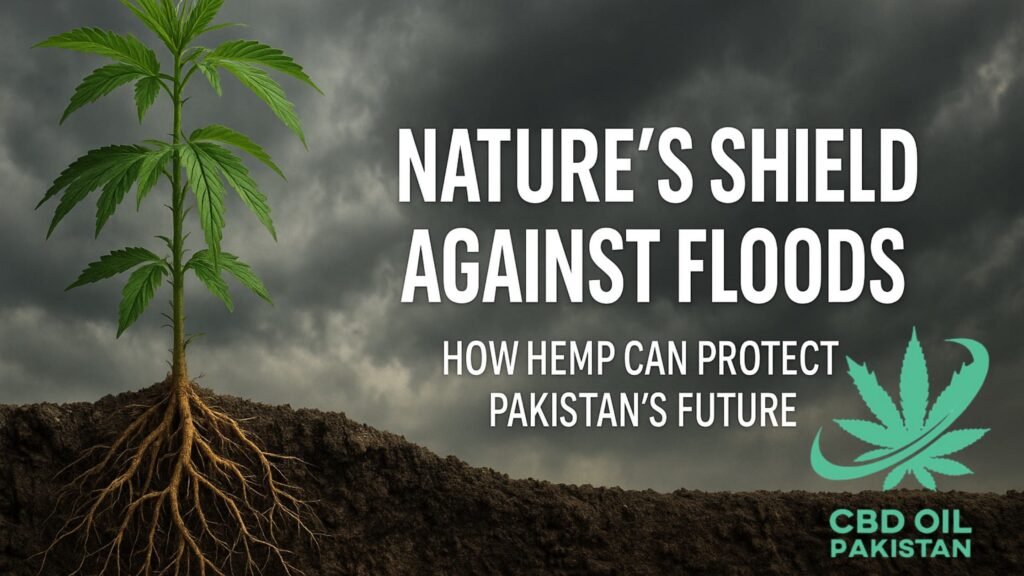
Thailand, another monsoon-prone country, has turned to industrial hemp as part of its climate resilience toolkit. Hemp is not just a cash crop—it is a living flood defense system.
Here’s how it works:
- 🌱 Deep Root Systems: Hemp develops roots up to 3 meters deep, stabilizing soil and preventing erosion (Amaducci et al., 2015).
- 💧 Water Absorption: Its root network absorbs and retains large amounts of water, reducing surface runoff and flash floods (Linger, 2002).
- 🧪 Soil Regeneration: Hemp is a phytoremediator, pulling heavy metals and toxins from the ground and restoring post-flood soil (Angelova et al., 2004).
- ⚡ Rapid Regrowth: Hemp grows up to 4 meters in 100 days, allowing quick replanting in damaged fields (Small & Marcus, 2002).
In Thailand, flood-affected regions where hemp was planted showed stronger soil resilience, reduced waterlogging, and faster agricultural recovery compared to traditional crops (Endoca, 2023).
Why Hemp Could Work for Pakistan
Pakistan’s geography and economy make it especially suited for hemp cultivation:
- Flood-prone lands in Sindh and Punjab could benefit from hemp’s soil-anchoring root systems.
- Farmers would gain new income streams from hemp fiber, seed oil, and full-spectrum extracts.
- Hemp cultivation requires less water and fewer pesticides compared to cotton, making it eco-friendly and economically viable (Farooq et al., 2019).
In a country where agriculture employs nearly 40% of the workforce, hemp could mean not just climate protection but also economic uplift.
Beyond Floods: Hemp’s Role in Human Wellness
Hemp does not only protect the land—it also contributes to personal well-being. Extracts from the plant, such as our Biohack Bliss Botanical Blend (Full Spectrum Hemp Extract, manufactured by Shamanic Biohacker LLC), are being studied for their potential to support:
- Stress reduction and relaxation (Blessing et al., 2015).
- Improved sleep and recovery (Babson et al., 2017).
- Inflammation balance (Nagarkatti et al., 2009).
In this way, hemp offers a dual solution: resilience for the earth, and balance for the body.
The Way Forward: Hemp for Pakistan’s Climate Strategy
To unlock these benefits, Pakistan needs:
- Policy Reform: Legal frameworks to encourage industrial hemp cultivation.
- Research Partnerships: Collaboration between universities, labs, and farmers.
- Public Awareness: Campaigns to show hemp as a climate resilience crop, not a taboo plant.
With the right steps, Pakistan could follow Thailand’s example—turning hemp into a green shield against floods and a driver of rural development.
Call to Action
At CBD Oil Pakistan (www.cbdvape-pakistan.com), we see hemp as more than a product—it’s a philosophy of resilience. Our flagship product, the Biohack Bliss Botanical Blend, represents how hemp can nurture both the land and the people.
🌱 Shop Now → Full Spectrum Hemp Extract CBD Oil in Pakistan
Conclusion
Pakistan’s floods have exposed the fragility of our land, economy, and communities. But nature also provides the tools for resilience. Hemp—already tested in Thailand—offers Pakistan a chance to strengthen soil, protect villages, and restore hope.
In a time of crisis, hemp is more than a crop—it is a lifeline.
References
- Amaducci, S., Scordia, D., Liu, F. H., Zhang, Q., Guo, H., Testa, G., & Cosentino, S. L. (2015). Key cultivation techniques for hemp in Europe and China. Industrial Crops and Products, 68, 2–16. https://doi.org/10.1016/j.indcrop.2014.06.041
- Angelova, V., Ivanova, R., Delibaltova, V., & Ivanov, K. (2004). Bio-accumulation and distribution of heavy metals in fibre crops (flax, cotton and hemp). Industrial Crops and Products, 19(3), 197–205. https://doi.org/10.1016/j.indcrop.2003.10.001
- Babson, K. A., Sottile, J., & Morabito, D. (2017). Cannabis, cannabinoids, and sleep: a review of the literature. Current Psychiatry Reports, 19(4), 23. https://doi.org/10.1007/s11920-017-0775-9
- Blessing, E. M., Steenkamp, M. M., Manzanares, J., & Marmar, C. R. (2015). Cannabidiol as a potential treatment for anxiety disorders. Neurotherapeutics, 12(4), 825–836. https://doi.org/10.1007/s13311-015-0387-1
- Endoca. (2023). Why hemp is the most effective method for preventing flooding in Thailand. Retrieved from https://endoca.asia
- Farooq, M., Wahid, A., Kobayashi, N., Fujita, D., & Basra, S. M. A. (2019). Plant drought stress: effects, mechanisms and management. Agronomy for Sustainable Development, 29(1), 185–212. https://doi.org/10.1051/agro:2008021
- Linger, P. (2002). Industrial hemp (Cannabis sativa L.) growing on heavy metal contaminated soil: Fibre quality and phytoremediation potential. Industrial Crops and Products, 16(1), 33–42. https://doi.org/10.1016/S0926-6690(02)00005-5
- Nagarkatti, P., Pandey, R., Rieder, S. A., Hegde, V. L., & Nagarkatti, M. (2009). Cannabinoids as novel anti-inflammatory drugs. Future Medicinal Chemistry, 1(7), 1333–1349. https://doi.org/10.4155/fmc.09.93
- Reuters. (2025, August 28). Pakistan evacuates a million people as farming belt hit by worst floods in decades. Retrieved from https://www.reuters.com/sustainability/climate-energy/pakistan-evacuates-million-people-farming-belt-hit-by-worst-floods-decades-2025-08-28
- The Associated Press (AP). (2025, August 28). Floods displace nearly 250,000 people and affect 1.2 million in eastern Pakistan. Retrieved from https://apnews.com/article/3800e85e1d2d743e1dd85e3f52e1ee94
- Small, E., & Marcus, D. (2002). Hemp: A new crop with new uses for North America. In J. Janick & A. Whipkey (Eds.), Trends in New Crops and New Uses (pp. 284–326). ASHS Press.